
Physician Salary Report 2026: Gains barely outpace inflation
June 25, 2026
Physicians continue to see steady, if relatively small, salary increases, according to the 2026 Medscape Physician Compensation Report. The annual report, compiled from surveys of U.S. physicians, provides a comprehensive view of physician salary trends across dozens of specialties.
The Medscape report notes that the average salary increase in 2025 is only slightly higher than annual inflation. This inflationary pressure may be driving a year-over-year increase in the percentage of physicians augmenting their pay with locum tenens and other outside work.
Despite seeing only small increases, physician attitudes toward their compensation have warmed over the past year, with more saying they feel fairly compensated.
Physician compensation is increasing
Physician compensation continues to grow, but at a slow and steady rate. The Medscape report found an overall average 3% increase in physician compensation in 2025. That’s right in line with a 2.9% increase in 2024 and a 3% increase in 2023.
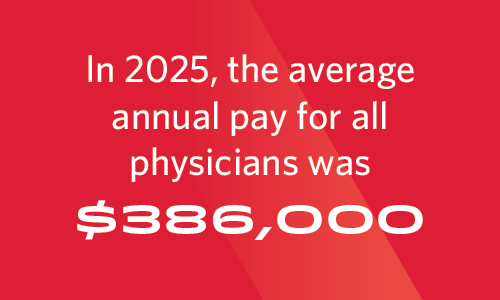
The growth rate was the same for all physicians and specialists. In 2025, the average annual pay for all physicians was $386,000. Specialists saw an average salary of $417,000.
Although the growth rate has held steady over the past few years, Medscape indicated that physician sentiment about their pay has improved, pointing to a “return to normalization” after the disruption of the COVID-19 pandemic. The percentage of physicians who feel fairly compensated rose year over year from 48% to 53%.
Another positive development is a decline in average weekly hours worked. In 2024, physicians reported an average workweek of 50 hours; that number fell to 49 in the most recent survey.
Trends in physician salaries by specialty
The majority of specialists also feel fairly compensated. About 41% of specialists reported a pay increase, while 42% said their compensation remained the same, leaving 17% with a year-over-year decrease.
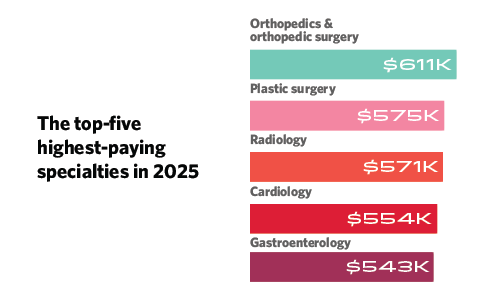
This year, for the first time, eight specialties clocked annual salaries of $500,000 or higher. (Last year, seven specialties reached this high point.) One specialty—orthopedics and orthopedic surgery—became the first specialty to top $600,000.
Looking at doctor pay by specialty, the top five specialties include orthopedics and orthopedic surgery ($611K), cardiology ($575K), radiology ($571K), plastic surgery ($554K), and anesthesiology ($543K). These have been the top five highest-paid specialties for the past few years, just with a slight shuffling of the order from year to year.
At 10%, cardiology had the largest growth rate. Ophthalmology and radiology each saw a 9% growth rate, while emergency medicine, anesthesiology, and orthopedics achieved 8% growth.
On the flipside, seven specialties experienced compensation declines. Psychiatry and allergy & immunology both had a -3% change in compensation, while pulmonary medicine and oncology each saw a -2% change. Physical medicine & rehabilitation, nephrology, and dermatology all experienced a -1% change.
Physicians are supplementing their income more than ever
About a quarter of all physicians, including specialists, said that their compensation does not cover their families’ needs. This may be one reason that a full 40% of all physicians report that they augment their pay with outside work—that’s up slightly from 38% in 2024.

Locum tenens is a useful tool for physicians who want to supplement their income in a way that fits into their busy lives. Locums offers competitive pay rates and a variety of assignment types, including short- and long-term, close-to-home, and travel assignments. Physicians with full-time, permanent positions can pick up locum shifts during their off hours.
What is the trend? 2026 Locum Tenens Physician Report
In fact, 60% of physicians who work locums do so in addition to other roles, according to CHG Healthcare’s 2025 Locum Tenens Experience Survey. On the other hand, 40% use locums as their primary career pathway to take advantage of higher salaries and greater flexibility.
"I had started doing locums while I had my full-time job to supplement my income and pay my student debt off quicker. Eventually, I realized I had full flexibility and was getting paid more doing locums than I was at my full-time job, and I could work the same amount and make a lot more money, or work less and make the same amount of money. Just staying at my full-time job didn't make any sense from a financial standpoint,” explains Dr. Ali Chaudhary, an emergency medicine physician.
Physicians receive the highest pay in the Midwest
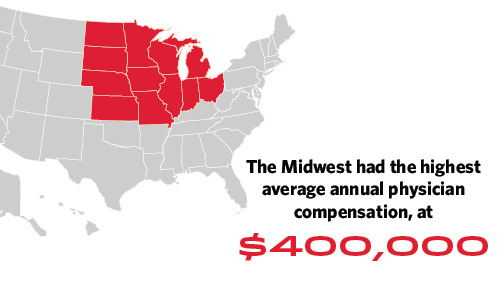
The Medscape report divides the U.S. into four regions: North, South, Midwest, and West. The Midwest had the highest average annual physician compensation, at $400,000. Medscape notes that salaries have risen in this region as employers seek to attract physicians to underserved rural areas. The next-highest region was the West at $390,000, followed by the South at $381,000. The North came in last at $375,000.
Regional differences can influence locum tenens salaries, too, and may offer physicians a way to earn more. “Where you work can dictate how much you make. And I think money is something important to think about. If you're going to travel and do locums, you should be compensated extra for that sacrifice of doing it,” said Dr. Ripal Patel, an emergency medicine physician.
Top locum tenens agencies: 6 companies to consider
A worsening gender pay gap
The gender pay gap has widened every year for at least the past four years, according to the annual Medscape reports.
This year, the pay gap between men and women physicians rose to more than $100,000 for the first time. Looking just at specialists, the pay gap is now $118,000. Many factors contribute to the gender pay gap among physicians, including structural hurdles, individual career choices, and bias.
Contract negotiation isn’t always an option
About a quarter of physicians reported that negotiation was not an option in their most recent contract. Many health systems are moving away from negotiating with physicians individually and instead creating standardized compensation structures.
When salaries are stagnating, and healthcare organizations won’t negotiate, locums gives physicians a way to supplement or increase their income. With locums, “everything is negotiable. Pretty much everything from schedule to shift on and off times to pay is negotiable to some extent,” says Dr. Nicholas Kusnezov, an orthopedic surgeon.
Go deeper: The finances of locum tenens
Locum tenens is an enticing career prospect
Physician salaries continue to achieve incremental gains and physicians express stronger satisfaction with their compensation. However, stagnant Medicare reimbursement rates and health systems' retreat from negotiation are putting downward pressure on physician compensation.
In this environment, a growing number of physicians are turning to outside work to supplement their income. Locum tenens allows physicians to earn higher salaries, negotiate pay and other terms, and benefit from flexibility.
Want to earn more and take control of your schedule? Locum tenens offers competitive pay, flexible assignments, and a chance to rediscover what you love about medicine. Give us a call at 888.714.2330 or view today’s locum tenens jobs to get started.
Recommended Articles
Categories

Thank you,
We appreciate you contacting us. A consultant will be reaching out to you shortly to discuss this job opportunity. You can also get in touch with us directly by calling 954.618.5296.